Showing posts with label Edith Wharton. Show all posts
Showing posts with label Edith Wharton. Show all posts
Monday, October 23, 2023

Friday, September 15, 2017


Monday, July 25, 2016

Wednesday, June 29, 2016

Saturday, January 24, 2015
Happy Birthday!

Edith Wharton was born "Edith Newbold Jones" in New York City on this day in 1862
Portrait of Wrthaon as a girl by Edward Harrison May (1870)
Friday, January 23, 2015
The recent shenanigans at the Cairo Museum ruining King Tutankhamun's mask brought this story to mind:

And I'm suddenly reminded of Edith Wharton's "False Dawn"
"Well, she died intestate, and Netta Kent--Netta Cosby--turned out to be
the next of kin. There wasn't much to be got out of the estate (or so
they thought) and, as the Cosby's are always hard up, the house in Tenth
Street had to be sold, and the pictures were very nearly sent off to the
auction room with all the rest of the stuff. But nobody supposed they
would bring anything, and the auctioneer said that if you tried to sell
pictures with carpets and bedding and kitchen furniture it always
depreciated the whole thing; and so, as the Cosbys had some bare walls to
cover, they sent for the whole lot--there were about thirty--and decided
to have them cleaned and hang them up. 'After all,' Netta said, 'as well
as I can make out through the cobwebs, some of them look like rather
jolly copies of early Italian things.' But as she was short of cash she
decided to clean them at home instead of sending them to an expert; and
one day, while she was operating on this very one before you, with her
sleeves rolled up, the man called, who always DOES call on such
occasions; the man who knows. In the given case, it was a quiet fellow
connected with the Louvre, who'd brought her a letter from Paris, and
whom she'd invited to one of her stupid dinners. He was announced, and
she thought it would be a joke to let him see what she was doing; she has
pretty arms, you may remember. So he was asked into the dining-room,
where he found her with a pail of hot water and soap-suds, and THIS laid
out on the table; and the first thing he did was to grab her pretty arm
so tight that it was black and blue, while he shouted out: 'God in
heaven! Not HOT water!'"
Friday, October 17, 2014
Edith slept here

127 Beacon Street, Boston. The home of Teddy Wharton and his parents. Edith spent her wedding night here and further subsequent visits.
Wednesday, October 8, 2014
Scarlett Johansson to star in limited TV series based on Edith Wharton novel

"Scarlett Johansson is the latest movie star to take a turn on the small screen.
The 'Avengers' actress has signed on to star and executive produce an eight-episode series based on the Edith Wharton novel, “The Custom of the Country,” according to Deadline. The series marks the 29-year-old’s first major TV role.
Johannson will play the story's heroine Undine Spragg, and the period drama will chronicle her quest to reach the heights of New York high society by any means necessary.
Fans of “Downton Abbey” might be inclined to tune in to the movie star's series, since “Downton” creator Julian Fellowes said that he was greatly inspired by the 1913 novel." via
Although not as well know nor widely read as House of Mirth, Age of Innocence or Ethan Frome. The Custom of the County is my favorite Edith Wharton novel. I highly recommend it
Although not as well know nor widely read as House of Mirth, Age of Innocence or Ethan Frome. The Custom of the County is my favorite Edith Wharton novel. I highly recommend it

Monday, August 11, 2014
When legends collide

Edith Wharton belonged to the old-money, upper-crust New York society to which F. Scott Fitzgerald aspired.
Wharton, like the much younger Fitzgerald, was an acclaimed novelist. She was also an arbiter of Victorian taste. Her first published work was an interior design book, The Decoration of Houses. In 1902, she designed and landscaped The Mount, her country home in Lenox, Mass. It was her first real home, she said.
Fitzgerald viewed Edith Wharton with awe and reverence. Scribner’s published both authors, and Fitzgerald claimed he once burst into her publisher’s office and knelt at her feet. His most famous novel, The Great Gatsby, was about a parvenu who died because of his love for a woman who belonged to the same elite class as Edith Wharton.
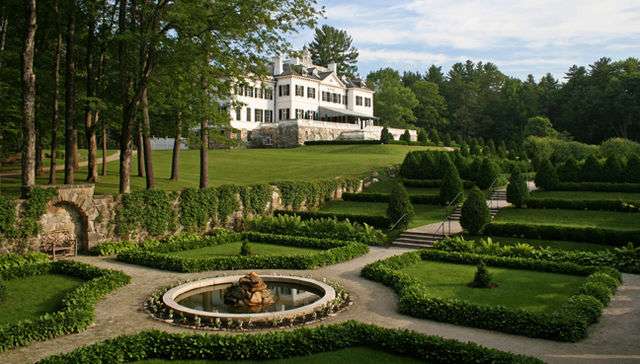
The Mount, Edith Wharton’s Berkshires home
Wharton’s marriage fell apart and she moved to France in 1920. It was there that she and Fitzgerald spent the disastrous afternoon of July 5, 1925 together.
Fitzgerald was 28 and had just published The Great Gatsby. He sent the 63-year-old Wharton a copy. In return, she invited him and his wife Zelda to tea at her home outside Paris. “To your generation, I must represent the literary equivalent of tufted furniture and gas chandeliers,” she wrote.
Zelda refused to go. She didn’t want to be made to feel provincial. So Fitzgerald invited Teddy Chanler, a mutual friend who would later become a music composer.
Fitzgerald got drunk on the way to Wharton’s house and found the tea party boring. He lunged around the elegantly furnished drawing room, than leaned against the mantel and told a risqué story. It was about an American couple who stayed in a Paris bordello, thinking it was a hotel.W
Edith Wharton was unimpressed with the story – it had no plot. She refilled his tea cup and said, “But Mr Fitzgerald, you haven’t told us what they did in the bordello.”
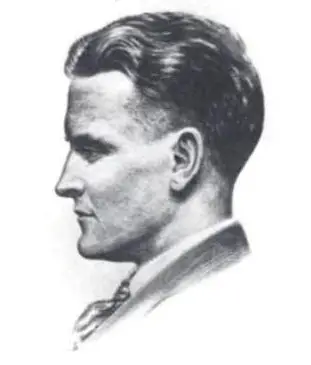
F. Scott Fitzgerald
Wharton recorded her impressions of the afternoon in her diary:
To tea, Teddy Chanler and Scott Fitzgerald, the novelist — awful.
Edith Wharton died on this day in 1937
Monday, May 26, 2014
On this day in 1891

Edith Wharton's first published story, "Mrs. Manstey's View," was accepted by Scribner's Magazine. Wharton's story did not come from the write-about-what-you-know school: she was 29 years old, brought up in wealth and high society, recently married to a prominent banker, and as opposite to her destitute heroine as she was to being a struggling young writer.
"Mrs. Manstey, in the long hours which she spent at her window, was not idle. She read a little, and knitted numberless stockings; but the view surrounded and shaped her life as the sea does a lonely island. When her rare callers came it was difficult for her to detach herself from the contemplation of the opposite window-washing, or the scrutiny of certain green points in a neighboring flower-bed which might, or might not, turn into hyacinths, while she feigned an interest in her visitor's anecdotes about some unknown grandchild. Mrs. Manstey's real friends were the denizens of the yards, the hyacinths, the magnolia, the green parrot, the maid who fed the cats, the doctor who studied late behind his mustard-colored curtains; and the confidant of her tenderer musings was the church-spire floating in the sunset."
--from "Mrs. Manstey's View"
Friday, January 24, 2014

Tuesday, December 3, 2013
First Upstairs Downstairs, then Downton Abbey....
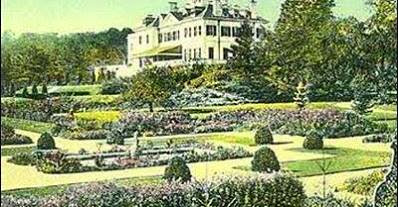
'Backstairs' tour at The Mount in Lenox helps tell servants' stories
By Derek Gentile, Berkshire Eagle StaffLENOX -- In addition to author Edith Wharton and her immediate family, there were anywhere from 16 to 20 people living and working at The Mount during her time there from 1901-11.
All of them had a story, and the curators of Wharton's early 20th century mansion are trying to tell some of those stories this month.
"It's something we don't usually talk about," said Ann Schuyler, who is one of the guides of the 40-minute tour.
On Saturday, the site hosted "Backstairs at The Mount," an examination of the servants who worked and lived there, according to Ann Shea, one of the House Managers at the Wharton estate. The tours will also run on Dec. 7 and 14. Read more here
Monday, October 14, 2013

Friday, May 17, 2013

Thursday, January 24, 2013

Tuesday, November 29, 2011

Wednesday, July 28, 2010
Died too soon, needed now more than ever....

A brief mention by Edith Wharton in her autobiography "A Backward Glance" introduced me to the novelist and muckraker "David Graham Phillips. Mrs Wharton had mentioned "Susan Lenox, Her Fall and Rise" as a very fine work and I followed her opinion.
How right she was. I read it immediately ( along with all his other titles) It's a piece of work that's always stayed with me and pokes up in my psyche every now and then in the most interesting of situations.
David Graham Philips is perhaps best known for producing one of the most important investigations exposing details of the corruption by big businesses of the Senate, in particular, by the Standard Oil Company. His article in Cosmopolitan in March 1906, called "The Treason of the Senate", exposed campaign contributors being rewarded by certain members of the U. S. Senate. The story launched a scathing attack on Rhode Island senator Nelson W. Aldrich, and brought Phillips a great deal of national exposure. This and other similar articles helped lead to the passage of the Seventeenth Amendment to the United States Constitution, initiating popular instead of state-legislature election of U. S. senators.
His own true story was no less interesting than his writing. Considered a progressive, a muckraker, a dandy and a ladies man, Phillips' reputation cost him his life in January 1911, when he was shot outside the Princeton Club at Gramercy Park in New York City. The killer was a Harvard-educated musician named Fitzhugh Coyle Goldsborough, who came from a prominent Philadelphia family. Goldsborough believed that Phillips' novel The Fashionable Adventures of Joshua Craig had cast literary aspersions on his family. (It has also been purported that Phillips was having an affair with Mrs Goldsborough, thus causing the shooting from jealous rage)
When confronting Phillips, Goldsborough yelled, "Here you go!" After Phillips collapsed, he yelled, "And here I go!", shooting himself in the head. Admitted to Bellevue Hospital, Phillips died there a day later.
Following Phillips' death, his sister Carolyn organized his final manuscript for posthumous publication as "Susan Lenox: Her Fall and Rise". In 1931, that book would be made into an MGM motion picture of the same name and starring Greta Garbo and Clark Gable.
Subscribe to:
Posts (Atom)