Showing posts with label Boston. Show all posts
Showing posts with label Boston. Show all posts
Thursday, October 8, 2020

Wednesday, March 15, 2017
Wednesday, December 21, 2016

Thursday, December 4, 2014

Wednesday, October 15, 2014
Ask any Anthony of a certain age....
We'll tell you we've been haunted by this commercial all our lives. And to make matters worse, even though I grew up Italian, Wednesday was always pot roast day at our house.
Thursday, May 22, 2014
Where the elite meet to eat and greet.
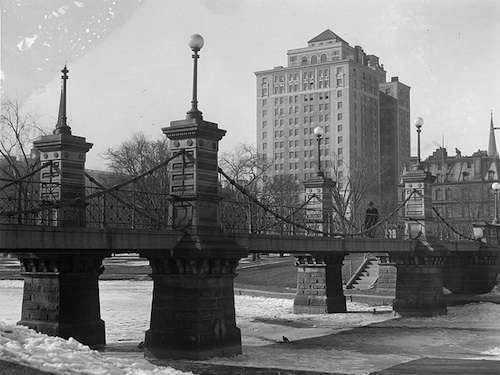
The Ritz-Carlton from the Public Garden. Photo courtesy Boston Public Library, Leslie Jones Collection.
In the spring of 1927, the Ritz-Carlton hotel opened in Boston and required guests to adhere to a dress code, forbade women to dine alone and sometimes rejected guests if they requested reservations on writing paper deemed too cheap.
It was a smashing success.
Boston’s Ritz-Carlton combined European luxury with Bostonian snobbery. It offered a bathroom in every guest room, a la carte dining according to Escoffier, waiters in white tie and fresh flowers everywhere.
Guests viewed the Ritz-Carlton as their private club, and their privacy was carefully guarded. The riff-raff was kept away. Hotel management checked to see if the guests were in the Social Register or Who’s Who.
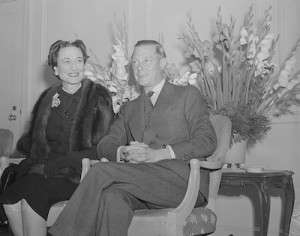
The Duke and Duchess of Windsor at the Ritz-Carlton. Photo courtesy Boston Public Library, Leslie Jones Collection.
The Ritz-Carlton Hotel was very nearly an apartment building called the Mayflower.
Edward Wyner, 29, was a real estate developer who had bought a third of an acre across from the Public Garden in 1926 and built the first two stories of an apartment building. Then he got a phone call from Mayor James Michael Curley, who persuaded him to build a world-class hotel instead.
Cesar Ritz, ‘the “king of hoteliers and hotelier to kings,’ had set the world standard for luxury, service, cuisine and privacy at the Ritz in Paris and the Carlton in London.
Ritz died in 1918, but his wife continued to expand the hotel management business bearing his name. Wynne got permission to use the Ritz-Carlton name.
On May 19, 1927 the Ritz-Carlton opened to Boston’s elite — at least those willing to pay $15 a for a room. The hotel’s signature dish was served that first night — Lobster au Whiskey. signifying the rich and insouciant tenor of the hotel. For although the Ritz-Carlton catered to the Social Register crowd, it was also a magnet for celebrities, world leaders and artists.
Privacy was protected — if you wanted it to be — and whims were indulged. Winston Churchill’s favorite color was red, so the furniture in his room was reupholstered in that color. Joan Crawford’s room was decorated with a theme of peppermint Lifesavers, her favorite candy.
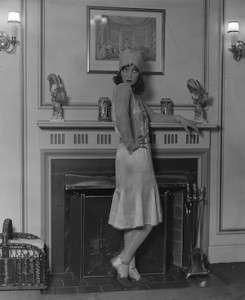
Clara Bow at the Ritz-Carlton. Photo courtesy Boston Public Library, Leslie Jones Collection.
The restaurants were a place to swing, as the Roof at the Ritz hosted Benny Goodman, Tommy Dorsey, Duke Ellington and Count Basie. Oscar Hammerstein wrote the lyrics to “Edelweiss” in the shower during a stay. Richard Rodgers composed Ten Cents a Dance on a piano in a Ritz-Carlton suite. Tennessee Williams wrote part of A Streetcar Named Desire while staying at the hotel.
Then came the Great Depression. Times were bad and Wynne struggled to keep up appearances. Though only 30 rooms of the hotel’s 300 were occupied one grim night, Wyner kept every light in the hotel on.
The Ritz-Carlton survived the Depression and remained Boston’s society hotel through the 1950s. Ed Wyner died of a heart attack in 1961. In 1964 the Ritz-Carlton Boston was sold to Gerald F. Blakeley and associates.
Blakeley owned the hotel for 20 years. It only made money in three of those years. But, he said, “from a public relations standpoint … it was a tremendous asset.”
From 1951 to 1975, the Ritz-Carlton Boston was one of only two Ritz-Carltons in the United States. The other one was in Atlantic City, and has since been converted to condominiums. In 1975, Blakeley sold the Ritz-Carlton trademark to real estate developer William Johnson, who expanded the company worldwide.
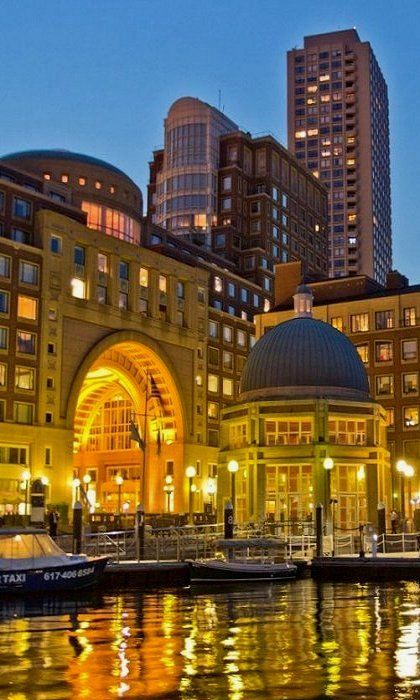
The Ritz-Carlton Boston is now the Taj Boston.
Saturday, March 22, 2014
Tuesday, April 16, 2013

Thursday, April 4, 2013
My olde towne

Supposedly this 1860 photograph of Boston is the world's oldest surviving aerial photo, taken in a hot-air balloon at 2,000 feet.
Wednesday, November 28, 2012
70 Years Ago Tonight

The Cocoanut Grove was Boston's premier nightclub during the post-Prohibition 1930s and 1940s. On November 28, 1942, this club was the scene of the deadliest nightclub fire in US history, killing 492 people (which was 32 more than the building's authorized capacity) and injuring hundreds more. It was also the second-worst single-building fire in American history; only the 1903 Iroquois Theatre fire in Chicago had a higher death toll, of 602.
The enormity of the tragedy shocked the nation and briefly replaced the events of World War II in newspaper headlines. In both fires, most of those who lost their lives would have survived had the existing safety codes been fully enforced. The tragedy led to a reform of safety standards and codes across the country, and major changes in the treatment and rehabilitation of burn victims.
Thursday, August 11, 2011

Subscribe to:
Comments (Atom)